
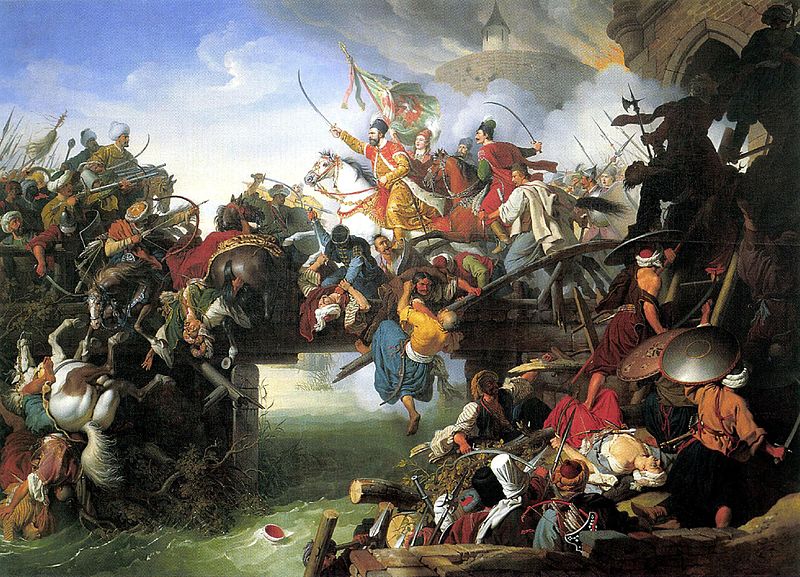
Nikola Šubić Zrinski’s Charge from the Fortress of Szigetvár by Johann Peter Kraft, 1825
I’m addicted to epics! I admit it. I’ve read 13 of them so far but a few days ago I stumbled upon The Siege of Sziget, the Hungarian national epic. Where had this one been hiding? Within the Hungarian language, apparently, as it has only recently been published for the first time ever in English. (THE SIEGE OF SZIGET by Miklos Zriny, as translated by László Kõrössy. Catholic University of America Press, 2011.)
The Siege of Sziget is a latecomer in the European epics. Written in 1647 by Miklós Zríny, it tells the story of the final battle of another Miklós Zríny (the author’s great granddad) against the Ottomans in 1566. The Ottomans were the victors but at a heavy cost with 20,000 Turks lost including Sultan Suleiman, their leader. However, it stopped the Ottomans from pushing forward towards Vienna that year and so from the Christian point of view, the Battle, although a loser, was successful.
From the the little I have read so far, The Siege of Sziget has all the characteristics of the traditional epic. It begins with an invocation to a Muse; there is a bloody battle; and things get mixed up (or conveniently arranged depending on one’s point of view) by the interference of the gods, or in this case, God. I’ll be adding The Siege of Sziget to the list of upcoming epics in the Global Reading Group, a virtual literary salon, so send me a note if you’d like to read along. http://moiramcpartlin.blogspot.co.uk/2014/04/epics-on-global-scale.html
For more info on The Siege of Sziget and its translation, visit
http://www.academia.edu/3039358/Review_of_Miklos_Zrinyi_The_Siege_of_Sziget_trans._Laszlo_Korossy_in_Times_Literary_Supplement_9_March_2012
And, as an extra bonus, here is Szigeti veszedelem, or The Siege of Sziget , in Hungarian.
http://szelence.com/zrini/index.html#tart
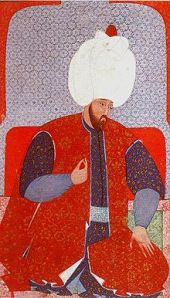
Suleiman the Magnificent as a young man by Nakkas Osman, 1579.
Topkapi Palace Museum
Istanbul Turkey
Photo courtesy of Bilkent University
Something of interest I discovered was that Suleiman, known as Suleiman the Magnificent, was also a poet and a big time supporter of the arts during his 46 year reign. Most of his poems were written to his wife, the daughter of an Orthodox priest who had been abducted and sold as a slave in Constantinople. Reportedly, the great Suleiman was quite mad about Hurrem Sultan—so much so that she was the only one of his harem he made his legal wife. You can read one of his lovely ghazals here: http://www.ottomansouvenir.com/General/Turkish_Poetry.htm#Gazel6#lateantiquitystudiesBudapest2014
My weekly prompt (feel free to use it too): Write a ghazal. Here are some words to consider incorporating in the poem: to crush, to blow, to swell, stiff-necked, Constantinople, blanket, and blood. Use a title of rank and the imperative “Believe, believe…”

 Alice-Catherine