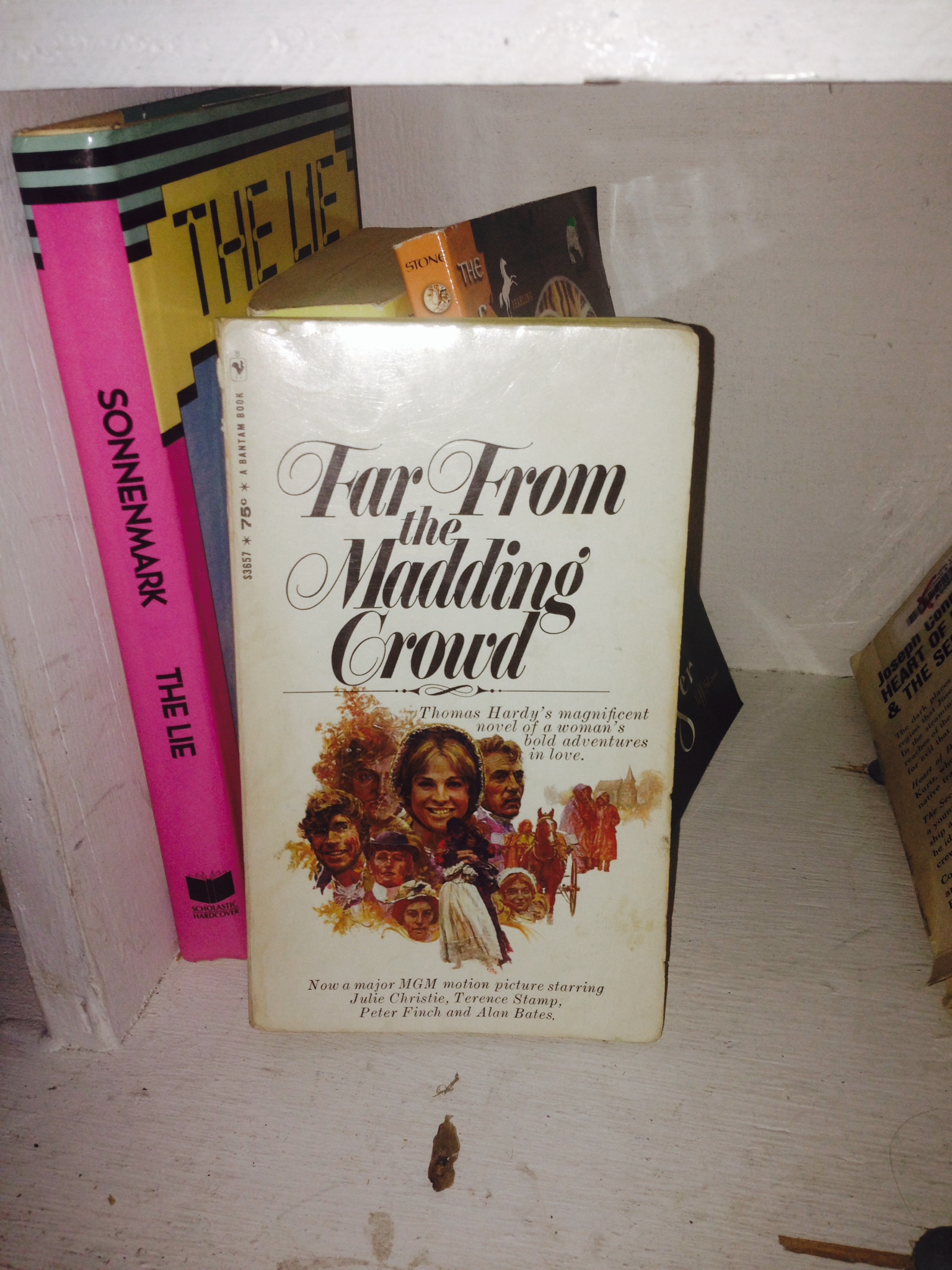
I ran into this Little Free Library in the Mutter Gottes Historic District in Covington, KY last Sunday night. It was fun to browse through the books and see what had been left.
<
Here’s Pearls S. Buck and a look at cultural imperialism….
And Thomas Hardy’s Far From the Maddening Crowd, which is where I wanted to go after 10 hours in airports on Monday.
I haled me a woman from the street,
Shameless, but, oh, so fair!
I bade her sit in the model’s seat
And I painted her sitting there.
MotherOfGod CC BY 3.0 Photo by Greg Hume
Whenever I visit a certain college friend in Cincinnati, he introduces me to something new, something really cool.
A couple of years ago, he took me to the Cincinnati Observatory , which houses the world’s oldest telescope. Yes, this is true.
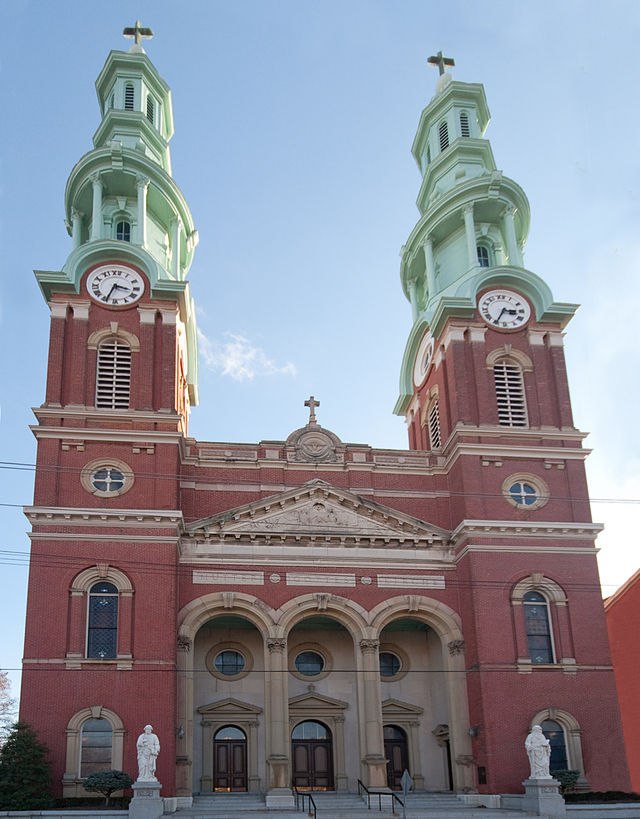
Last weekend, he led me to the Mutter Gottess, which is actually in Northern Kentucky but within walking distance of Ohio.
Mother of God Church (Covington, Kentucky), CC BY-SA 3.0 Photo courtesy of Nheyob
Then came, with a knowing nod,
A connoisseur, and I heard him say;
“’Tis Mary, the Mother of God.”
Mutter Gottes, or Mother of God, is a vibrant Catholic Parish in the Mutter Gottes Historic District in Covington, KY. The original church was built in 1842 but soon the parish outgrew its size and its second building was dedicated on September 10, 1871.
It turned out to be a Mary-Mother-of-God sort of weekend as I had spent the night before at my 8th grade reunion at Our Lady of the Rosary School.
As a result of twelve years of Catholic education, I’ve had a full serving of Mariology and Mary portraits so it was fun to find Service’s poem, “My Madonna.”
Robert_W._Service
Robert Service was a British-Canadian known as the “Bard of the Yukon.” During his lifetime he was a well-known and commercially successful poet yet Service never called his work poetry. ““Verse, not poetry, is what I was after.”
So I painted a halo round her hair,
And I sold her and took my fee,
Shorter and shorter now the twilight clips
The days, as though the sunset gates they crowd,
1850 portrait of Alice Cary in New York City which hangs in her childhood home in North College Hill, Ohio .Photo courtesy of Rick Dikeman
Over the weekend I made a quick trip to Ohio for the confluence of an 8th grade reunion & a visit to a failing mother. 8th grade reunion??? Yes. This was our third one!
How did we all fit in that small classroom?
Those who made us laugh when we were kids can make us laugh again.
While those who had a flare for the dramatic arts still do.
Alice Cary and her sister, Phoebe, were born in Mt. Healthy, Ohio—not that far from my elementary school—and raised on a farm that is now a part of North College Hill. Their poetry was noticed by famous writers such as Edgar Allen Poe. After their book Poems of Alice and Phoebe Cary was published, the two sisters moved to New York City, where they became part of the literary salon scene.
Cary Cottage, childhood home of Alice and Phoebe Cary near Cincinnati, Ohio
Our reunion was held on the summer solstice, the day that marks the changeover from the lengthening of the day to its shortening. For me, this day evokes the season that follows, or “Autumn.”
The robin, that was busy all the June,
Before the sun had kissed the topmost bough,
Yet, the day was June, a time of pop-out green in Cincinnati.
“Consider the Hands that Write this Letter”
BY ARACELIS GIRMAY
after Marina Wilson
Left palm pressed flat against paper,
as we have done before, over my heart,…
For the last week, I’ve been at war with the mail—junk mail that is. It was taking over my psyche. I needed some peace, some comfort so I looked to poetry, my reliable friend.
Arecelis Girmay’s poem reminded me of the beauty of receiving hand written notes. I used to have a daily practice of writing one note a day to a friend.
I looked forward to the selection of the notecards, the decision as to what to say, what not to say— the physicality of walking to the mail box and slipping each note into that slim slot.
Could I revive this practice, I mused. I doubt it. With social media, I no longer track street addresses.
The rush of receiving Christmas cards—I miss it. I used to hang all that color and glitter around the front door. Ted Kooser’s poem “Christmas Mail” calls up that era.
Cards in each mailbox,
angel, manger, star and lamb
“The Poem Bodies Make” by Luis Alberto Ambroggio, as translated by Naomi Ayala
Behold the poem the bodies
of gods who love one another make;
This poem is so lovely, its language so lush. The call to the reader loops me in—to the poem, the image.
Listen to how they knock against each other with the breath of waves;
heart open, light infusing them;
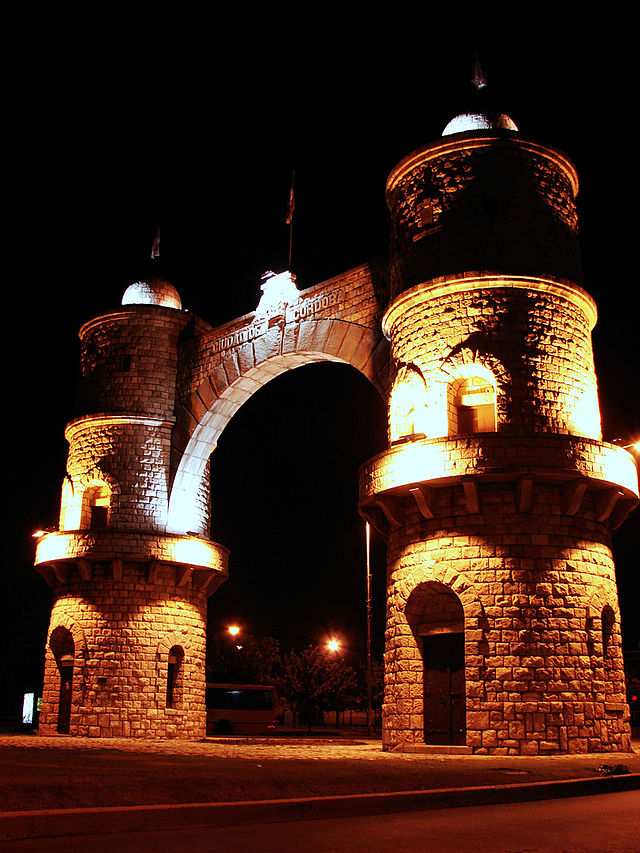
Arco de Córdoba 2007-11-16 CC BY-SA 2. Photo courtesy of Walter Gomez –
Ambroggio was born in Córdoba, Argentina. Although I have never been to Argentina, I have a touch of it close by at Esquina Tango. Dance classes, Yoga, Latin American films and Spanish conversation—it’s a fun place.
High heels and dancing make me smile. I rarely dance but when in Austin I head to Esquina Tango and catch Salsa Aerobics on Saturdays. The foot moves are fast. I’m off beat most of the time yet I find myself feeling lighter, more hopeful. Perhaps it is the music, the lift and tilt of the Spanish language.
Speaking of lift, here is one of Ambroggio’s poems in Spanish, “Mi Primer Vuelo”, or “My First Flight.”
Con mi sonrisa feliz
le traigo algo del sol triunfante.
12.
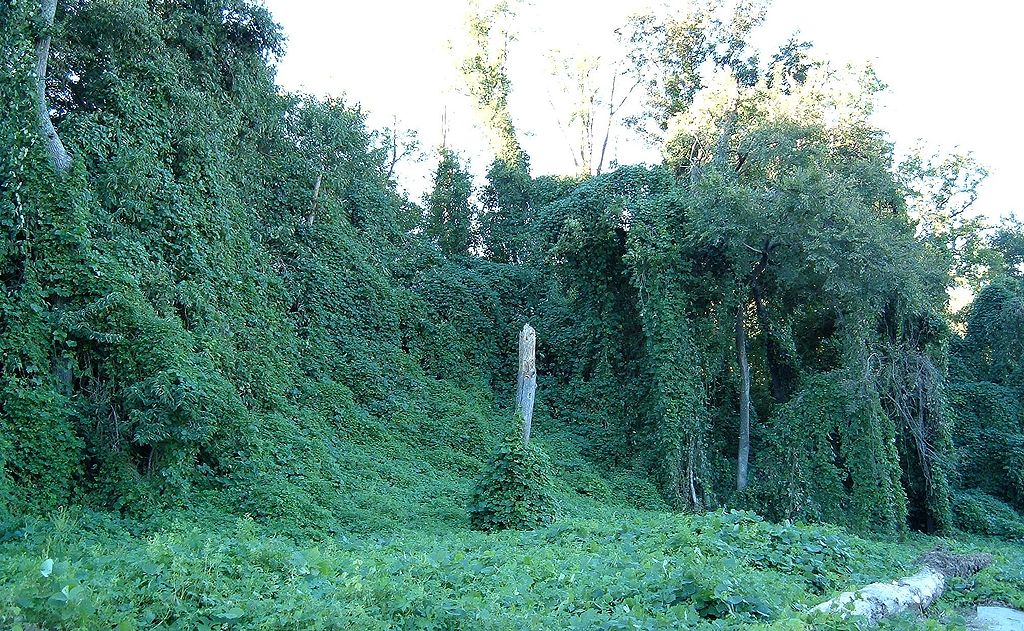
Common names include
Mile-a-minute-vine
foot-a-night-vine
cuss-you-vine
drop-it-and-run-vine.
Covering seven million acres,
and counting. Photo courtesy of Scott Ehardt
For four years, my husband and I traveled back and forth to Oxford, MS while our daughter was a student at The University of Mississippi. Now that she has graduated and moved on, we miss Ole Miss—The Grove, The Square, and Ajax.
We timed out trips from Texas to reach Oxford in time for lunch at Ajax. Predictably, I always ordered the vegetable plate. The expression “vegetable plate” sounds flat and thin; it cannot begin to evoke the blessed experience of eating a plate of mashed potatoes, squash casserole, fried okra and cheese grits with a glass of $4.50 white wine.
I first encountered kudzu in Mississippi. I thought it was so green, fertile, lovely until I discovered that its shade kills the tree it covers. This invasive weed was introduced to the US in 1876 at the Centennial Exposition in Philadelphia.
4.
I asked a neighbor, early on,
if there was a way
to get rid of it—
Well, he said,
over the kudzu fence,
I suppose
if you sprayed it
with whiskey…
Fennelly’s “Kudzu Chronicles” is a book length poem in thirteen sections. Reading it is a journey back and forth in history—from the actual to the personal and return. Each section surprises and takes us somewhere unexpected.
and let them nibble acorns off my grave.
Then let the kudzu blanket me,
For the first time since 1972, the Ole Miss baseball team is in the College World Series. Sunday at 7 CDT is the first game vs Virginia. I’ll be cheering them on with other Ole Miss fans at a watch party in Austin. Bourbon, tailgate food and “Hotty Toddy’s” all around. It won’t be Oxford—or Omaha for that matter—but it will be as close as we can get.
“Sophomores” by Meghan O’Rourke
From Halflife,
W.W. Norton & Company, 2007
It’s America, 1993, and the malls
are cool and clean. Don’t you know,
like me, no one gets out alive.
Morning Walk Photo courtesy of John Jennings
For my last “Poetry at the Post” this cycle, I decided—after 18 worldwide poets— to return home with a writer who has ties to this part of Texas.
I read O’Rourke’s Halftime several years ago and several of the poems touched me deeply. Yesterday afternoon, while dusting (so much endless dusting in the desert…) and rearranging books, I rediscovered Halflife. I flipped through it at random and settled on “Sophomores.”
As we know, a poet’s poem becomes something else in the hands of each reader. Shaped by personal experiences, we see things in them that perhaps were never meant to be.
Last fall, I spent a few months living in Medellin,Colombia in a high rise apartment within walking distance of an upscale mall. It was super: swank pool, tropical landscape and two large patios with views of the Andes and the city below. However, if I just wanted to step out for a walk and grab a bite to eat, pick up some milk, etc. I had to go to the mall.
The little I knew before hand about Medellin did not prepare me for the locals’ love of Malls. Everything is in the malls, including the supermarkets.
“Weren’t you scared in Colombia?” I’m often asked. Not necessarily but I was careful. However, I did have a fear that I would never “get out of the malls.”
Medellin My walk to the Mall
Of course, O’Rourke’s poetry is so much more than malls and my musings on my past.
My favorite line from “Sophomores” is “I’m the princess with a hole in my heart.” I’ve felt like that before. Perhaps not a princess, but a woman with a “hole in her heart.”
I look forward to reading O’Rourke’s newest book The Long Goodbye, A Memoir.
“Five Matryoskas”by Gennady Aygi, as translated by Sarah Valentine
Russian-Matroshka Dolls CC BY-SA 3.0
3 with an idea
You surround us
as with silk
When I was a child I had a set of Russian Matryoshka Dolls. I’m not sure who gave them to me, or whatever happened to them but I used to love playing with these wooden dolls, nesting and un-nesting them. Who knows? Perhaps these little dolls were the spark that guided me to major in Russian.
“Gennady Aygi (1934-2006) is widely considered to be one of the great avant-garde poets from the former Soviet Union.” The starkness of his poetry attracts me. In “Five Matryoshkas, a poem inspired by the birth of Aygi’s son, we begin in the center of the nest and move outward—in a series of five fragmentary moments. Each section is like each doll in itself—complete.
Here’s a video of Sarah Valentine reading a selection of Aygi’s poems:
Into The Snow, Selected Poems of Gennady Aygi, Translated by Sarah Valentine, Wave Books, 2011
The past
Is but the cinders
Of the present;
The future
The smoke
That escaped
Into the cloud-bound sky.
2010 Opening Ceremony – Ghana entering CC BY 2.0v Jude Freeman
Ghanaian poet, Kwesi Brewe (1928 – 2007), was a poet-diplomat in the tradition of a long line of poets from Chaucer to Octavio Paz.
“The Search” suggests for me life’s journey on the pathway for truth and wisdom. I find interest in this intersection of philosophy and religion, the East and the West:
When wise men become silent,
It is because they have read
The palms of Christ
In the face of Buddha.
Yes, there is “rain” in this poem. It’s as if my subconscious is witching for water. It is hot and dry in the West Texas desert. We await the rain.
“Thus Bare Shoulder’d” by Gülseli İnal, as translated by Sebnem Susam
Pale and forgetful I was
returning from the lands of rain on my wings raindrops… which had fought with Zephyr
Yes, I am dreaming about rain in the hot desert and in this poem I found myself in the middle of a myth, a dream, the fairies. I could sense the wind—from the west, the raindrops. I felt the magic, the story.
William-Adolphe Bouguereau (1825-1905) – Flora And Zephyr (1875)
…be it yours
these crystal fingers thus bare shoulder’d be it yours this this rose-
leaved temple.

 <
<





 Alice-Catherine